
OWASP MASTG for CRA compliance in mobile apps: coverage and gaps
How OWASP MASVS and the MASTG fit the CRA for a mobile app: which points of Annex I they cover, which they leave open, and how to close the gaps.
You can use OWASP MASVS and the MASTG to show that a mobile app meets the Cyber Resilience Act (CRA). Both come from OWASP Mobile Application Security (MAS): MASVS, the Mobile Application Security Verification Standard, says what a secure app does, and the MASTG, its Testing Guide, gives the tests that check it.
In practice, you list MASVS and the MASTG in your technical documentation as specifications you applied, and you file the MASTG report as a test report. That covers the app, but the backend the app talks to is part of the product too. OWASP has two other projects for it: the Application Security Verification Standard (ASVS) and the Web Security Testing Guide (WSTG).
None of these four OWASP documents gives you a presumption of conformity, and none covers most of the vulnerability handling that Part II of Annex I asks for. The CRA sets what your product must achieve and leaves the proof to you. For the app itself, OWASP MAS is still the most complete method I know, because it links each requirement to the test that checks it.
TL;DR
- Covers: Where MASVS and the MASTG fit in the CRA file of an Android or iOS app, which points of Annex I they cover for the app and which they leave open, how ASVS and the WSTG cover its backend, and which added tests close the gaps.
- Not covered here: The full reasoning on whether the CRA applies to your app is in does the CRA apply to my mobile app, and how to choose a MAS profile is in Jacobo Casado’s which MASVS profile does your app need.
- First step: If you already have a MASTG report, check its scope and profiles against the two coverage tables below to see which points of Annex I it leaves open.
The example: a supermarket loyalty app
Imagine a supermarket chain with a loyalty app, which we will call Demo Market. Customers collect points, activate coupons, show a barcode at the till and can save a card to pay for home delivery. The app costs nothing to download. Each section below checks its question against Demo Market, starting with whether the CRA applies to it.
Does the CRA apply to your app?
Demo Market is in scope. It is installed and runs on the phone, the chain supplies it as part of how it sells, its customers are in the EU, and it is not medical device software, the main exclusion for apps (Article 2(2)). The price plays no part, so a free app can be in scope too. A website or a progressive web app (PWA) used only in a browser, on the other hand, is not a product on its own (guidance, point 21). The reasoning behind each of these questions, and the harder cases, are in does the CRA apply to mobile apps.
Two questions settle most cases: whether the app is installed and run on the device, and whether you supply it in the course of a business. After them, the app’s core functionality decides its category and the conformity route, which the next sections explain:
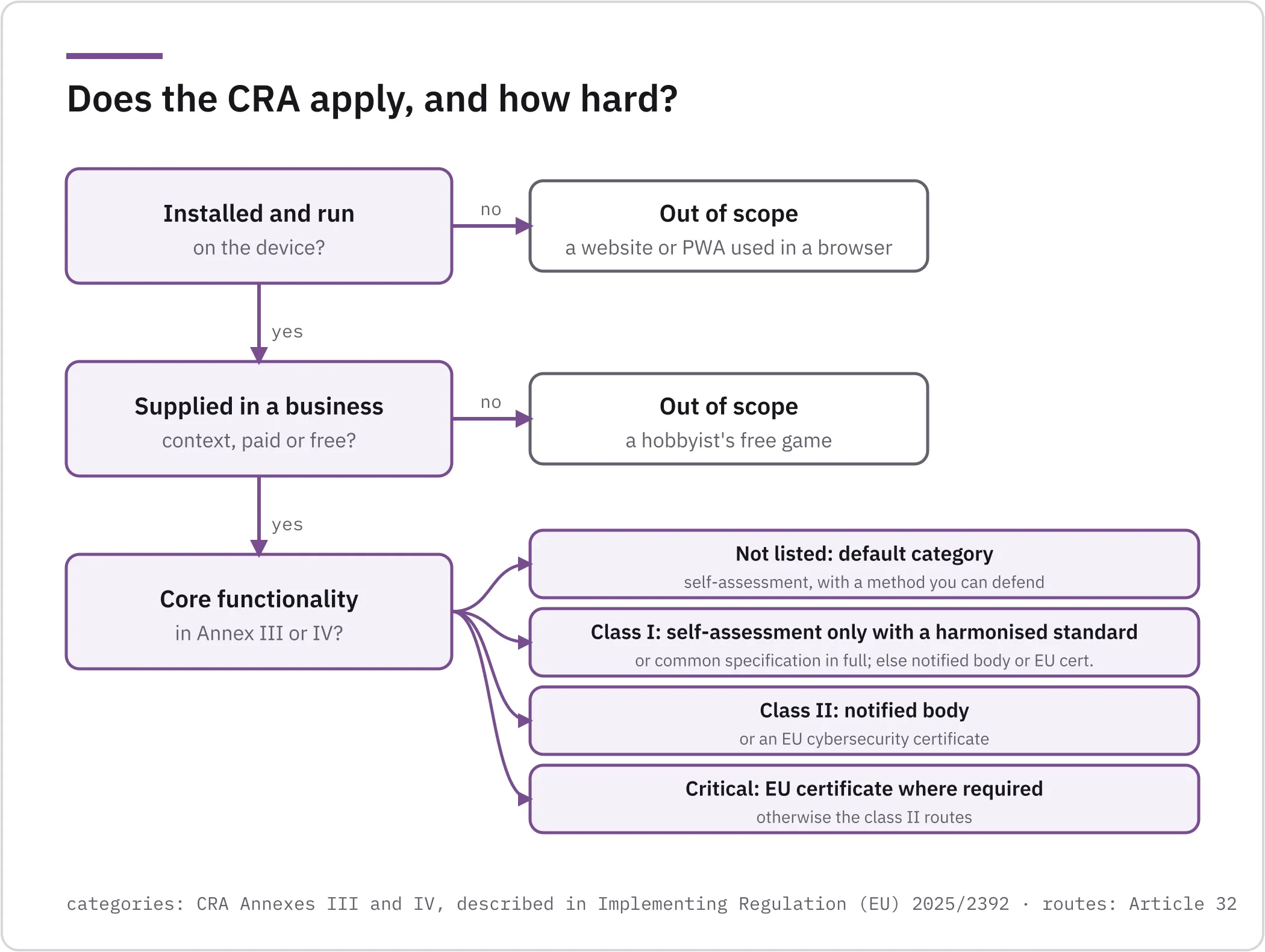
If an agency built the app, the supermarket is still the manufacturer, because the manufacturer is whoever puts the app on the market under its own name (Article 3(13)).
Is your app’s backend part of the product?
Yes, the parts the app talks to directly. The product includes its remote data processing solutions (RDPS): the processing at a distance that you designed and developed, or had built under your responsibility, and without which the app could not perform one of its functions (Article 3(2)). For the supermarket, that is the points API, the coupon API and the chain’s own payment API for home delivery, which sits in front of its payment processor.
A system that sits behind those APIs and that the app never reaches, such as the points ledger, stays outside the product (CRA guidance, section 8.3.1). So does a service run by a third party, such as a payment processor. Both still enter your analysis: a system behind your APIs stays in the risk assessment as a dependency, and for a third-party service you assess the risks it brings and exercise due diligence on it.
For the supermarket, the points, coupon and payment APIs are the product and get tested, while the back-office systems behind them stay outside as dependencies:
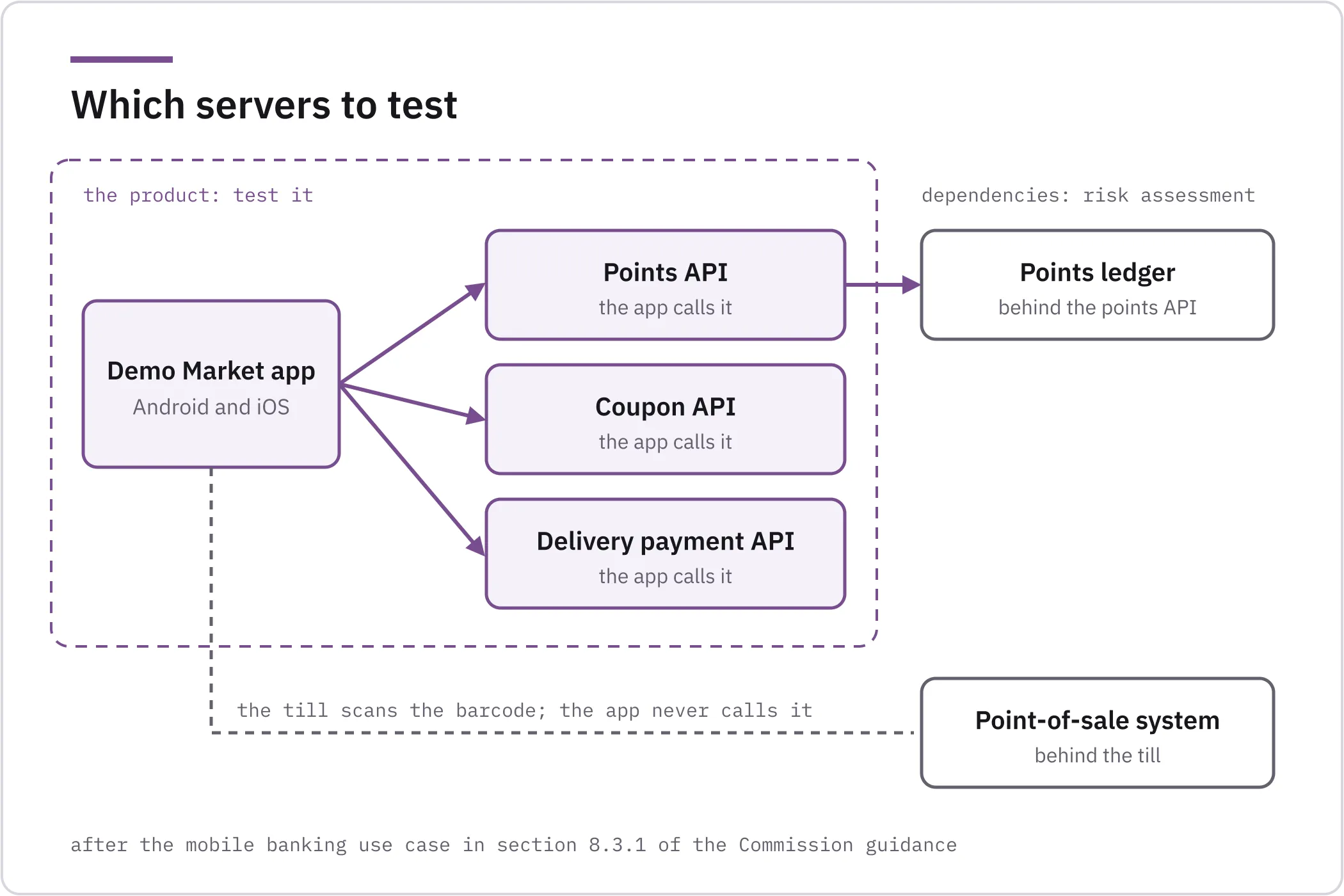
The harder cases, such as a backend that the website and the app share, and the guidance’s mobile banking example, are in does the CRA apply to mobile apps.
The two halves get tested with different standards. OWASP MAS covers the app, and for the RDPS, ASVS (v5.0.0, 30 May 2025) gives the requirements and the WSTG the tests. MASVS and the MASTG themselves point to ASVS and the WSTG for remote endpoints.
Which of the four CRA categories is my app in?
Most likely the default category. The four categories are default, important class I, important class II and critical, and the category decides who checks your proof: you alone, a notified body or the issuer of an EU certificate.
Your app leaves the default category only when its core functionality is one of the products listed in Annexes III and IV of the CRA, which Implementing Regulation (EU) 2025/2392 describes one by one. Core functionality means the main features and technical capabilities without which the product would not meet its intended purpose (point 139 of the Commission’s guidance). Your sector and the size of your company play no part in it.
Demo Market collects points and shows coupons, which is retail, and nothing in those lists fits it. So it goes in the default category.
An app is class I when it is an authenticator or one-time password app, a password manager, a standalone browser, anti-malware or a VPN app. It is also class I when it is the app a manufacturer provides for its own class I device, such as a smart lock, a security camera or a wearable that monitors health, because the two form a single product (the guidance’s Example 9). Building a third party’s class I SDK into your app, such as an authenticator SDK, does not move your app into class I (Article 7(1)); your duty is due diligence on it.
Each category also points to the OWASP MAS profile I would start from. MAS defines its default profiles by who the attacker is:
- L1, essential security: other apps on the device are the adversary.
- L2, advanced security: the operating system cannot be trusted, and the attacker may hold the phone.
- R, resilience: the user is the attacker, for example a reverse engineer or a cheater.
- P, privacy: it protects users’ personal data rather than countering an attacker.
The further down the table, the more an outside body checks your proof:
| Category | Mobile apps that fall here | How you show conformity | MAS profile to start from |
|---|---|---|---|
| Default | Loyalty, retail, fitness apps that do not come with the maker’s tracker, and most banking apps even when they confirm payments, since their core functionality is banking | Self-assessment (internal control, module A) with a method you can defend | L1, then L2, P or R as the risk assessment requires |
| Important, class I | Authenticator and one-time password apps, password managers, browsers, anti-malware, VPN apps, apps that come with a class I device | Self-assessment if you apply a harmonised standard or common specification in full; otherwise a notified body or an EU cybersecurity certificate | L2, with R by risk; R for authenticators |
| Important, class II | Rarely an app: hypervisors, firewalls and intrusion detection, tamper-resistant chips. A firewall app is the likely exception | A notified body or an EU cybersecurity certificate | L2, with R by risk |
| Critical | Not an app: hardware security boxes, smart meter gateways, smartcards and secure elements | An EU certificate where a delegated act requires one; otherwise the class II routes | Not an app |
With no harmonised standard cited today, a class I app goes to a notified body in practice. The full decision table by type of app, the grey cases such as a gym app that also opens the turnstile, and what a notified body checks at each release are in CRA conformity assessment for mobile apps.
How do MASVS, MASWE and the MASTG connect to Annex I?
In the default category, you choose how to show conformity, as long as you can defend your choice. There is no harmonised standard to lean on yet, so in my view the best defence is to show that your method is the state of the art. For the app itself, that means OWASP MAS.
The chain starts with the MASVS (v2.1.0, 18 January 2024), which sets 24 controls for the app. MASWE, the Mobile Application Security Weakness Enumeration (v1.0.0, 17 August 2026), breaks those controls into 78 weaknesses, each with a requirement in one sentence. The tests for those weaknesses sit in the MASTG (v2.0.0, 30 June 2026), and each one ends with the condition under which it fails. That release came out before MASWE v1.0.0, so the links between tests and weaknesses in this article are those of the MASTG main branch.
Each document narrows the one before, so one point of Annex I ends in a test result:
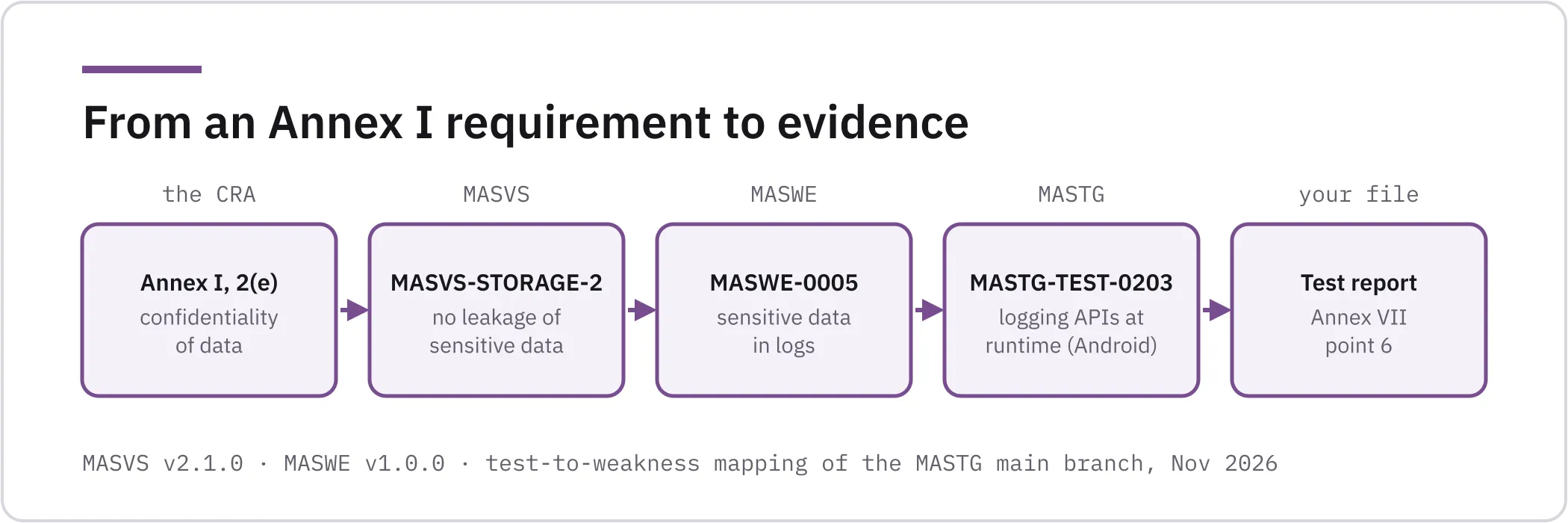
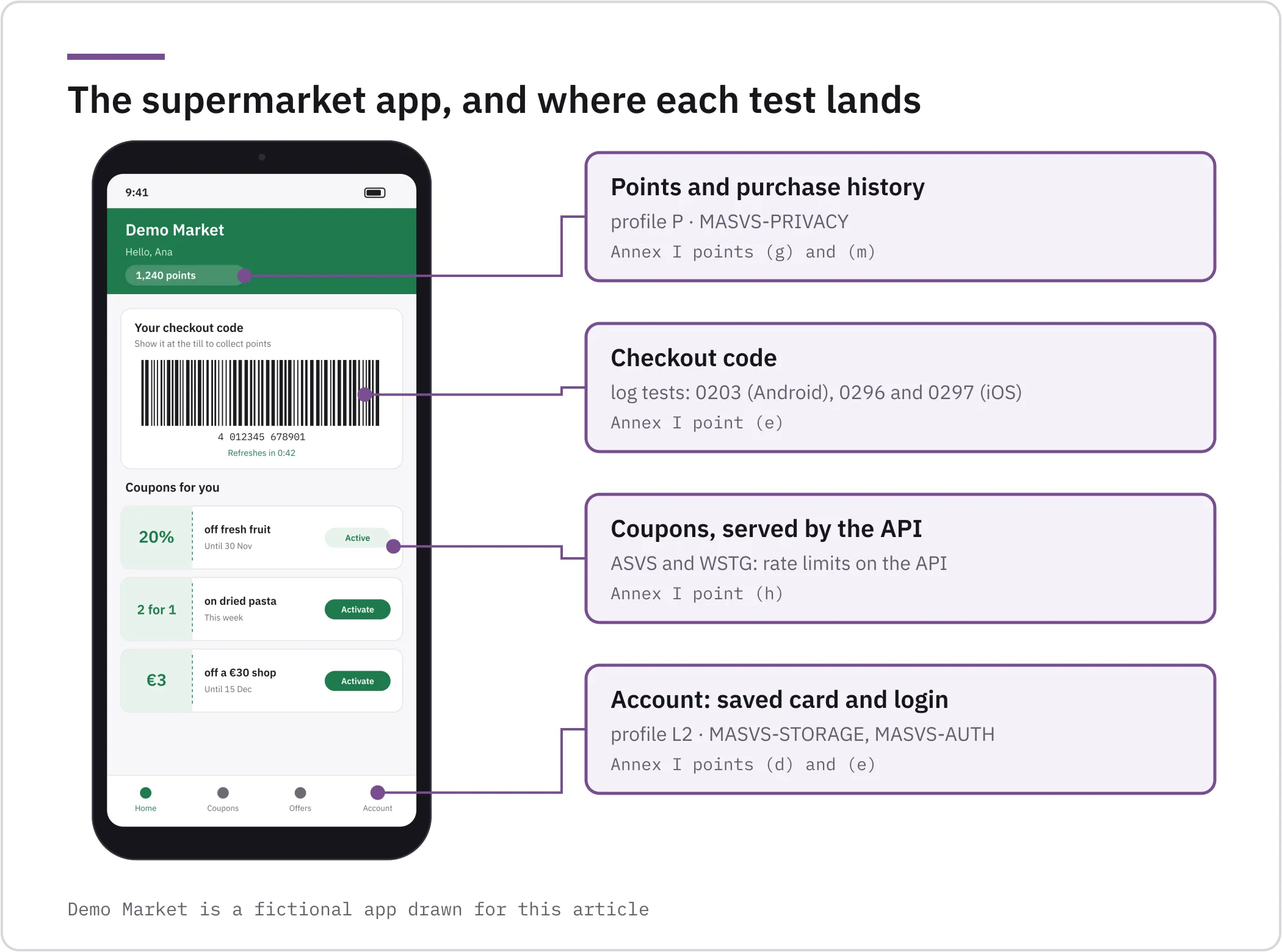
Follow the supermarket’s checkout barcode through that chain. The chain starts at Annex I, Part I, point 2(e), which asks for confidentiality of data. MASVS-STORAGE-2 turns that into a control for the app, preventing leakage of sensitive data, and MASWE-0005 narrows it further: “The app excludes sensitive data from application logs.” Finally, MASTG-TEST-0203 checks at runtime whether the barcode reaches the Android log; MASTG-TEST-0296 and 0297 do the same on iOS.
None of the three OWASP documents mentions the CRA, though, so linking each control to a point of Annex I is the job of whoever writes the technical documentation.
Where the MASTG report goes in your technical documentation
Only three things give you a presumption of conformity: harmonised standards cited in the Official Journal, common specifications and EU certification schemes (Article 27). OWASP MAS is none of them, and calling something a “MASVS certificate” does not make it one. OWASP itself says it “does not certify any vendors, verifiers or software”.
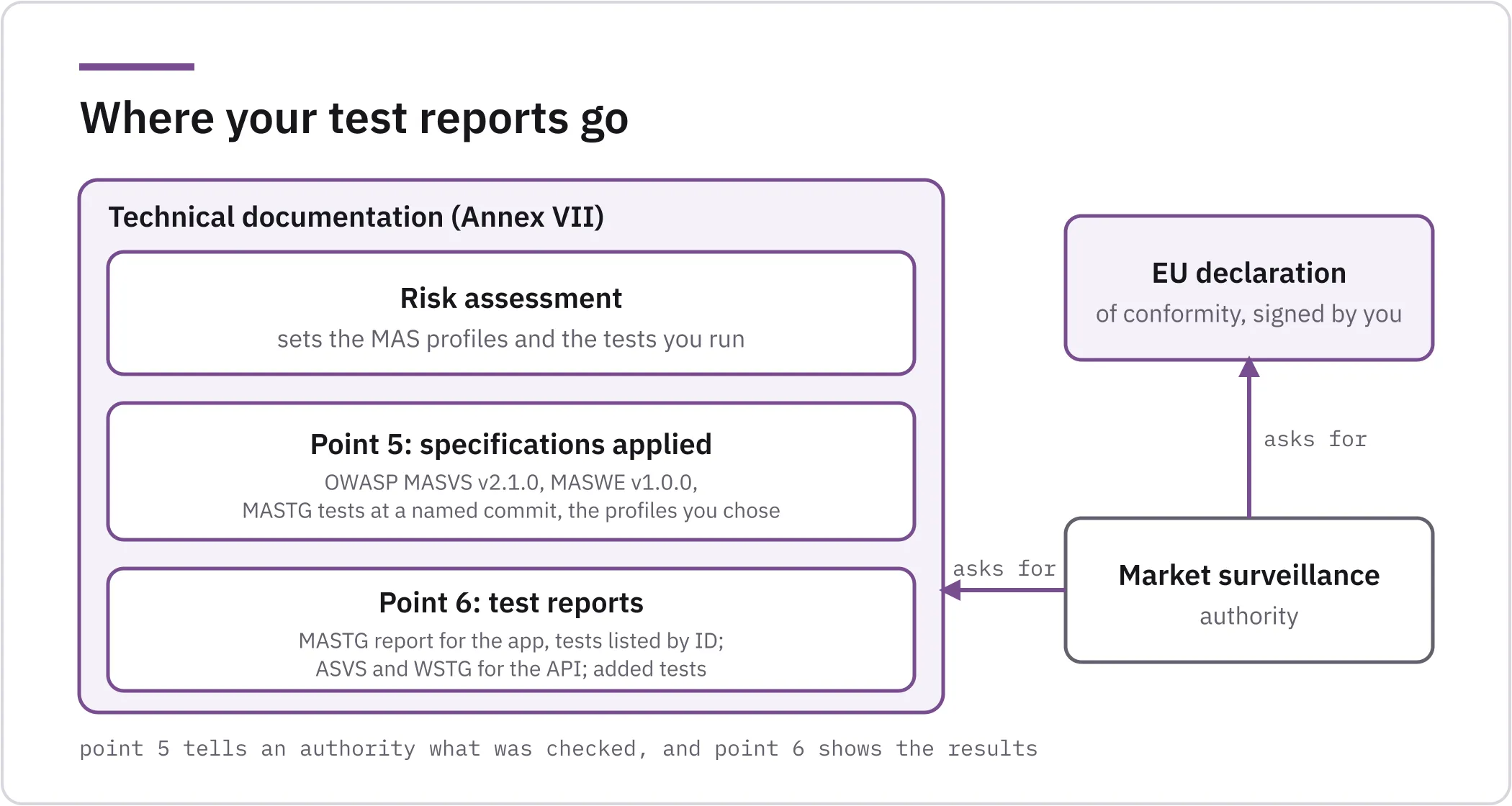
As of early November 2026, no harmonised standard under the CRA is cited in the Official Journal, so you describe the solutions you adopted, “including a list of other relevant technical specifications applied” (point 5 of Annex VII). My reading is that MASVS, MASWE and the MASTG belong on that list, with their versions and the profiles you chose. The MASTG report is then one of the “reports of the tests” that point 6 asks for.
In the file, the line can be as plain as this: “OWASP MASVS v2.1.0, MASWE v1.0.0 and the MASTG tests at commit 2eb0f70 of 24 October 2026, profiles L1 and L2, tests listed by ID in report section 3”. That line tells a market surveillance authority what was checked and how to repeat it. Name the MASTG commit and not only the release, because since September 2026 a test takes its profile from its weakness, and the same test can belong to a different profile in another version.
The risk assessment, that line and the test reports all go into the technical documentation, and an authority asks for it together with the declaration of conformity you sign:
The future standards are to include evaluation procedures “such as testing and review, with objectively verifiable criteria”, in the words of the Commission’s standardisation request of February 2025. MASTG tests come close to that: MASTG-TEST-0203 fails “if you can find sensitive data being logged”, but deciding what counts as sensitive is still the tester’s call, so the report should say how that call was made.
Which harmonised standards will apply to apps?
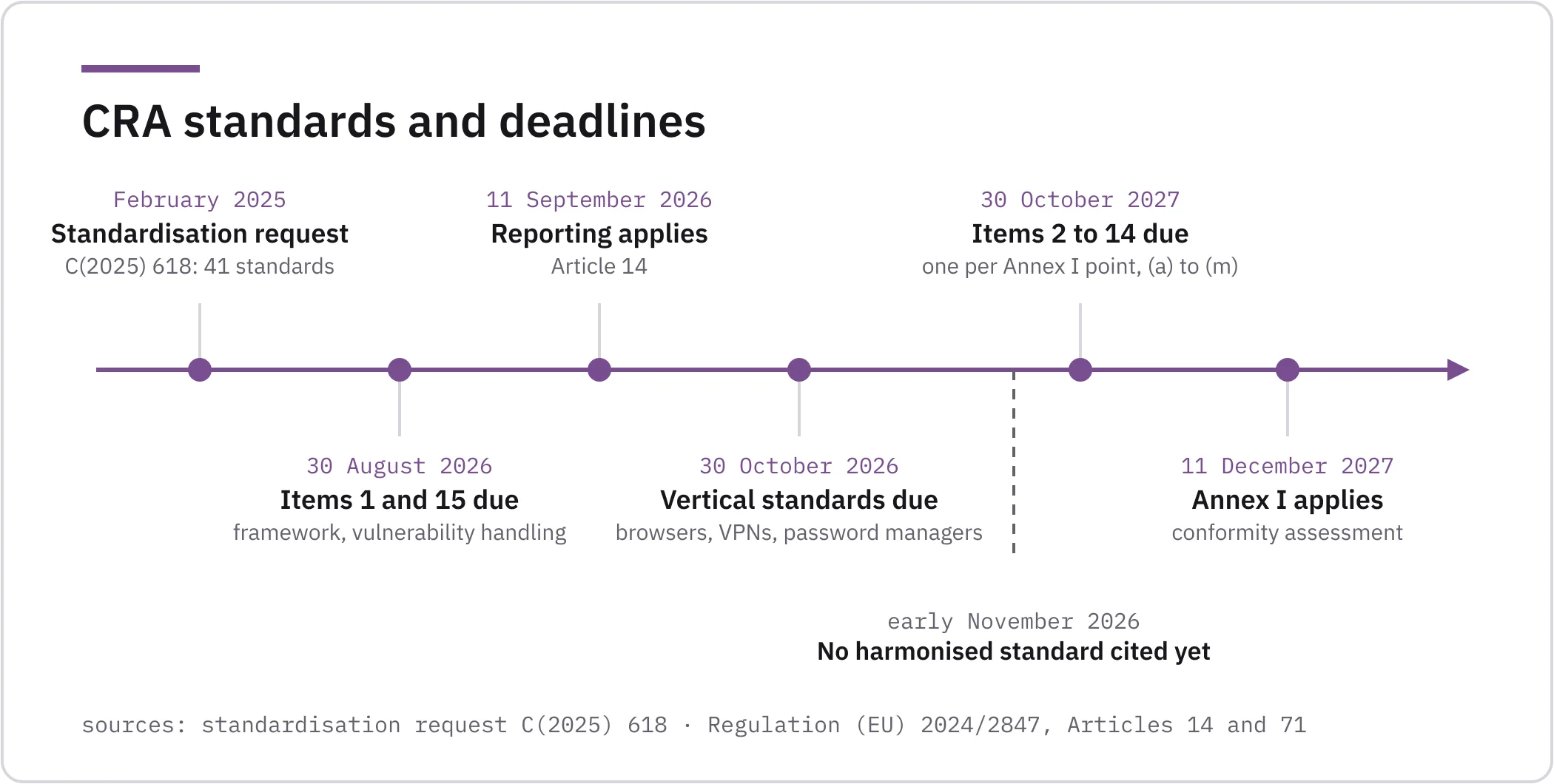
The request asks for 41 standards of two kinds. Vertical standards cover the important and critical categories, such as browsers or password managers, and none is written for mobile apps as such. Horizontal standards, on the other hand, apply to any product, so they will apply to yours.
There are 15 horizontal standards in the request. Item 1 is the framework: designing a product so that its cybersecurity matches the risks. Items 2 to 14 follow Annex I point by point, one standard for each property from (a) to (m), and item 15 covers vulnerability handling, which is Part II.
The horizontal standards should support manufacturers “particularly for products not covered by existing or planned vertical standards” (in the request’s words), which describes a loyalty app. Once they are cited, applying them will give the app a presumption of conformity for the requirements they cover.
Items 1 and 15 were due on 30 August 2026, and that date has passed with neither of them cited in the Official Journal. Items 2 to 14 have until 30 October 2027. I expect the horizontals to say what to evaluate in any product, and MASVS and the MASTG to keep saying how to do it in an app. Each row of the two tables in the next section matches one of items 2 to 14, so a mapping built today can be checked against those standards when they arrive.
On the CRA’s own calendar, items 2 to 14 are due shortly before Annex I applies:
How much of Annex I do the OWASP standards cover?
The product must have thirteen properties, (a) to (m), wherever the risk assessment says they apply (Annex I). That product is the app plus its RDPS, so each property gets checked on both sides. The two tables below are my mapping, illustrative rather than official.
The app: OWASP MAS
This table covers the app alone. MASWE numbers are those of v1.0.0.
| Point | Annex I asks for | Where OWASP MAS helps | Coverage | What is left |
|---|---|---|---|---|
| (a) | No known exploitable vulnerabilities | L1, L2 and P tests; MASVS-CODE-1 and CODE-3 for platform versions and libraries | Partly | The 35 of 78 MASWE weaknesses that have no test yet |
| (b) | Secure default configuration and a way to reset | MASVS-NETWORK-1 and MASVS-PLATFORM, partly; MASWE-0071 on privacy defaults, with no test yet | Partly | Privacy defaults and the reset (added tests) |
| (c) | Security updates, automatic by default, with opt-out and postponement | MASVS-CODE-2 enforces updates, which pulls against postponement and opt-out | Partly | Postponement (added test); automatic updates are mostly store settings |
| (d) | Protection from unauthorised access, and reporting it | MASVS-AUTH, MASVS-PLATFORM-1 | Covered | Nothing on the app side; the server authorises and reports |
| (e) | Confidentiality of data | MASVS-STORAGE, MASVS-CRYPTO, MASVS-NETWORK | Covered | Nothing |
| (f) | Integrity of data, commands, programs and configuration | MASVS-NETWORK-1, MASVS-CODE-4; with profile R, MASVS-RESILIENCE-2 covers the integrity of the app itself | Partly | Reporting corruption (added test) |
| (g) | Data minimisation | MASVS-PRIVACY; only permissions and data declarations have tests yet | Partly | The other privacy controls, which have no tests yet |
| (h) | Availability, including against denial of service | Nothing | Not covered | How the app behaves while the API is down (added test) |
| (i) | Limited impact on other networks | Nothing | Not covered | A reason in the risk assessment |
| (j) | Limited attack surface | MASVS-PLATFORM, MASVS-CODE-4 | Covered | Nothing |
| (k) | Exploitation mitigation | MASVS-CODE, with MASWE-0045 on compiler features; MASVS-RESILIENCE | Covered | Nothing |
| (l) | Recording security events, with an opt-out | Nothing; MASVS-STORAGE-2 only limits what the records may contain | Not covered | The recording happens mostly on the server |
| (m) | Secure removal of all data, and secure transfer | MASVS-PRIVACY-4, MASWE-0076 with no test yet | Partly | Local data after the account is deleted (added test) |
On the app side, OWASP MAS covers four properties in full and six in part. The other three, (h) availability, (i) impact on other networks and (l) security event recording, play out mostly on the server or in the risk assessment.
The RDPS: ASVS and the WSTG
This table covers the APIs the app calls. Requirement numbers are those of ASVS 5.0.0.
| Point | Annex I asks for | Where ASVS and the WSTG help | Coverage | What is left |
|---|---|---|---|---|
| (a) | No known exploitable vulnerabilities | A WSTG test of the API; ASVS 15.2.1 (components within their remediation time frames) | Covered | Nothing |
| (b) | Secure default configuration and a way to reset | ASVS 6.3.2 (no default accounts), 13.4.2 (debug modes off), 13.4.5 (internal documentation and monitoring not exposed) | Covered | The reset, which concerns the app |
| (c) | Security updates, automatic by default, with opt-out and postponement | ASVS 15.1.1 and 15.2.1 (remediation time frames for components) | Covered | Automatic updates and opt-out, which concern the app |
| (d) | Protection from unauthorised access, and reporting it | ASVS chapters 6 to 8 (authentication, sessions, authorisation); 6.3.5 (notify users of suspicious sign-ins); 16.3.1 and 16.3.2 (log authentication and authorisation failures) | Covered | Nothing |
| (e) | Confidentiality of data | ASVS chapters 11, 12 and 14 (cryptography, secure communication, data protection) | Covered | Nothing |
| (f) | Integrity of data, commands, programs and configuration | ASVS 2.2.2 (validation at a trusted service layer), 4.1.5 (per-message signatures), 15.3.3 (mass assignment) | Partly | Rejecting repackaged copies of the app: MASWE-0056 asks for it, but no test checks the backend yet (added test) |
| (g) | Data minimisation | ASVS 14.2.3 (no sensitive data to untrusted parties), 14.2.6 (return only the minimum) | Partly | Deciding what the backend collects, which is a process |
| (h) | Availability, including against denial of service | ASVS 2.4.1 (anti-automation), 15.2.2 (resource-demanding functions), 16.5.2 (graceful degradation); WSTG-BUSL-05 (limits on how often a function can be used) | Partly | Behaviour under real load, which takes a load test |
| (i) | Limited impact on other networks | ASVS 13.2.4 and 13.2.5 (allowlists for outbound requests) | Partly | The rest, in the risk assessment |
| (j) | Limited attack surface | ASVS 15.2.3 (no extraneous functionality in production), 13.4.5 | Covered | Nothing |
| (k) | Exploitation mitigation | ASVS chapter 1 and 15.3 (encoding and defensive coding) | Partly | Hardening of the operating system and platform |
| (l) | Recording security events, with an opt-out | ASVS chapter 16 (security logging) | Partly | The customer’s opt-out from monitoring (added test) |
| (m) | Secure removal of all data, and secure transfer | ASVS 14.2.7 (data retention), 7.4.2 (sessions ended on account deletion) | Partly | Deleting the account’s data on request, and export (added test) |
ASVS covers most of the backend’s share. Two checks, though, are in no OWASP standard at all: whether the API honours the customer’s opt-out from monitoring, and whether deleting an account deletes the data behind it. A third, whether the API rejects repackaged copies of the app, is a MASWE weakness whose tests do not reach the backend yet.
Which tests cover each part of Demo Market?
On Demo Market’s own screen, each feature maps to the profile or tests that cover it and to the Annex I points behind it:
Is a failed MASTG test an exploitable vulnerability?
Point (a) is narrower than it looks, because the regulation defines an exploitable vulnerability as one with “the potential to be effectively used by an adversary under practical operational conditions” (Article 3(41)). A failed MASTG test shows a weakness. Whether that weakness is exploitable in your product is a separate question.
Your own internal testing can make a vulnerability known, but a finding alone does not prove that the vulnerability is exploitable, and the manufacturer has to investigate (points 234 and 235 of the Commission’s guidance). For the log test, that investigation looks like this.
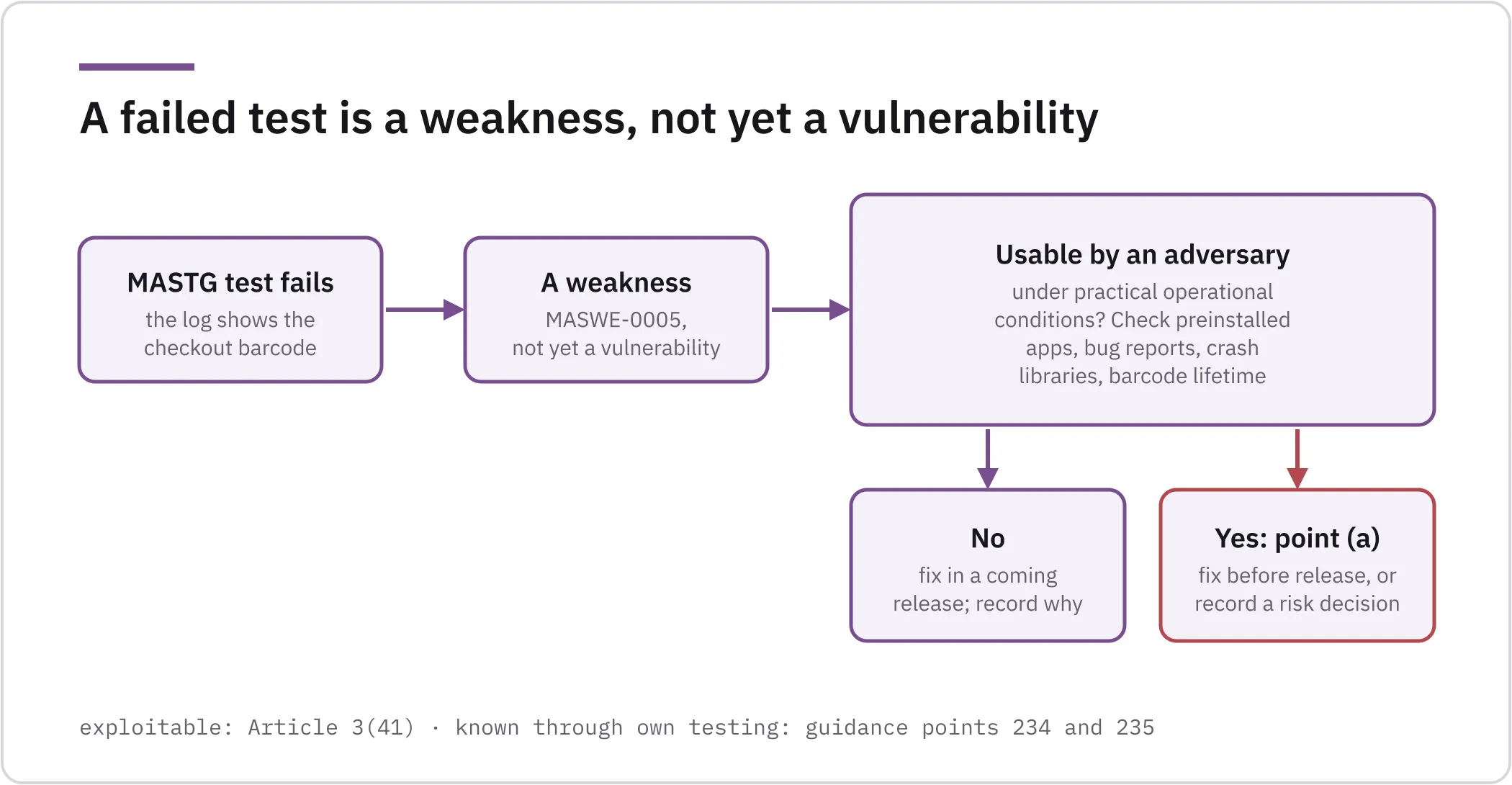
Take MASTG-TEST-0203 from the chain above, and suppose it fails: the barcode, which the app refreshes every minute, shows up in the system log. Since Android 4.1, ordinary apps cannot read other apps’ logs, but preinstalled apps with the READ_LOGS permission can, and the log can leave the phone in a bug report sent to support or through a crash reporting library that collects it. The assessment checks those paths.
The assessment also weighs what an attacker gets out of it. With a barcode that expires in a minute, an attacker collects someone else’s points at one till, once. If none of the paths applies, I would treat the finding as a weakness to fix in a coming release, even though the test belongs to the baseline L1 profile. If a path does apply, point (a) applies too. For a vulnerability found shortly before release, you may weigh fixing it first against shipping, on a risk-based decision that you record (point 237).
Darío Abad runs that investigation on a whole scanner report, and ranks what is left with CVSS 4.0, in mobile pentest findings: which are real and what to fix first.
The CRA asks for a process to handle vulnerabilities, so the first sanctions may follow that process rather than the flaws. If I had to bet, the first serious trouble will go to manufacturers who fail to report an exploited vulnerability on time.
The opposite result has a limit too: a clean MASTG report says nothing about the weaknesses that have no test, and at MASTG commit 2eb0f70 of 24 October 2026 that was 35 of the 78.
Which MAS profile does your app need for the CRA?
The one your risk assessment supports. The CRA asks for a level of cybersecurity appropriate to the risks and names no MAS profile, and your risk assessment has to state whether and how each of the thirteen properties applies (Article 13). So I take the profile from the risk assessment, and the reasoning goes into the technical documentation next to it.
By OWASP’s own example apps, Demo Market, with points worth money and a saved card, sits next to the banking app, at L2+P+R. Jacobo Casado’s guide to the MAS profiles explains how to choose a profile and which tests each one adds.
Inside one app, the profile can change from feature to feature, which OWASP allows. In Demo Market, each feature starts from the profile its own risk calls for:
| Feature | Profile | Why |
|---|---|---|
| Coupons and offers | L1 | The baseline is enough to start |
| Saved payment card and login | L2 | Whoever steals a session can pay with the saved card |
| Purchase history | P | P holds MASVS-PRIVACY and the controls behind points (g) and (m), though few of them have tests yet |
| The app’s own integrity | R, if the risk assessment names a threat | Repackaged copies passed around outside the store to harvest customers’ logins |
Profile R, for tampering with the app itself, needs a concrete threat in the risk assessment, such as those repackaged copies, and point (f) covers that kind of unauthorised change to a program. Whether the API rejects such a copy is a separate weakness, MASWE-0056 (app attestation), also in profile R. Its MASTG tests so far check how the app is signed, so that backend check joins the added tests below.
Leaving R out is a valid choice when the risk assessment gives the reason, because the lack of resilience measures “does not necessarily cause vulnerabilities” (MASVS v2.1.0).
How do you test what OWASP does not cover?
Our proposal is to fill the gaps in the same shape that MASWE and the MASTG already use: a one-sentence requirement for each gap, small tests that say what to look at and when they fail, and the evidence kept next to each result. Each added test carries our own label, so nobody mistakes it for OWASP content.
Each “added test” in the coverage tables above becomes a check with its own evidence:
| Gap | Side | What we test | Evidence |
|---|---|---|---|
| (b) secure defaults and reset | App | List every security and privacy setting with its default on a fresh install, such as whether the app asks for a PIN before showing the saved card; then reset the app and look for what survives | Settings list; app storage before and after the reset |
| (c) update handling | App | Whether the app tells the customer an update is available and lets them postpone it for a while, security updates included, and how release notes flag security fixes | Screens and release notes |
| (f) reporting corruption | App | Modify local data and configuration, then check that the app notices and tells the customer or the backend | Files changed and the app’s reaction |
| (f) repackaged copies | RDPS | Send API requests from a re-signed copy of the app and check whether the API tells it apart | Requests and responses |
| (h) availability | App | How the app behaves while the API is down | Screens |
| (i) impact on other networks | Both | Not a test: assess it in the risk assessment and, where it does not apply, write the reason | The justification |
| (l) recording with opt-out | RDPS | That the customer’s opt-out from monitoring exists and works | Records before and after the opt-out |
| (m) data removal | App and RDPS | Delete the account from the app, then check local storage, backups and the backend | Storage and API responses after deletion |
What the CRA asks after release
Since 11 September 2026, you have to report actively exploited vulnerabilities and severe incidents through the single reporting platform (Article 14): an early warning within 24 hours, a notification within 72 hours and a final report afterwards. That duty covers apps that were already on the market too.
Everything else applies from 11 December 2027: Annex I, the software bill of materials (SBOM), the technical documentation, the CE marking and a support period that is, as a rule, at least five years.
SBOM, CVEs and VEX
Part II starts with the SBOM. A test of the binary can show where the SBOM is wrong: libraries the build lists that the APK does not contain, or code that sits in the APK without a line of its own.
Cross even a modest app’s SBOM with the CVE list of public vulnerabilities and with the EUVD, ENISA’s European Vulnerability Database, and you get a long list, most of which does not affect the app. VEX, the Vulnerability Exploitability eXchange, records for each CVE whether the product is affected and why, in a format such as CSAF or CycloneDX. Each CVE then gets its VEX status from what a test finds in the build:
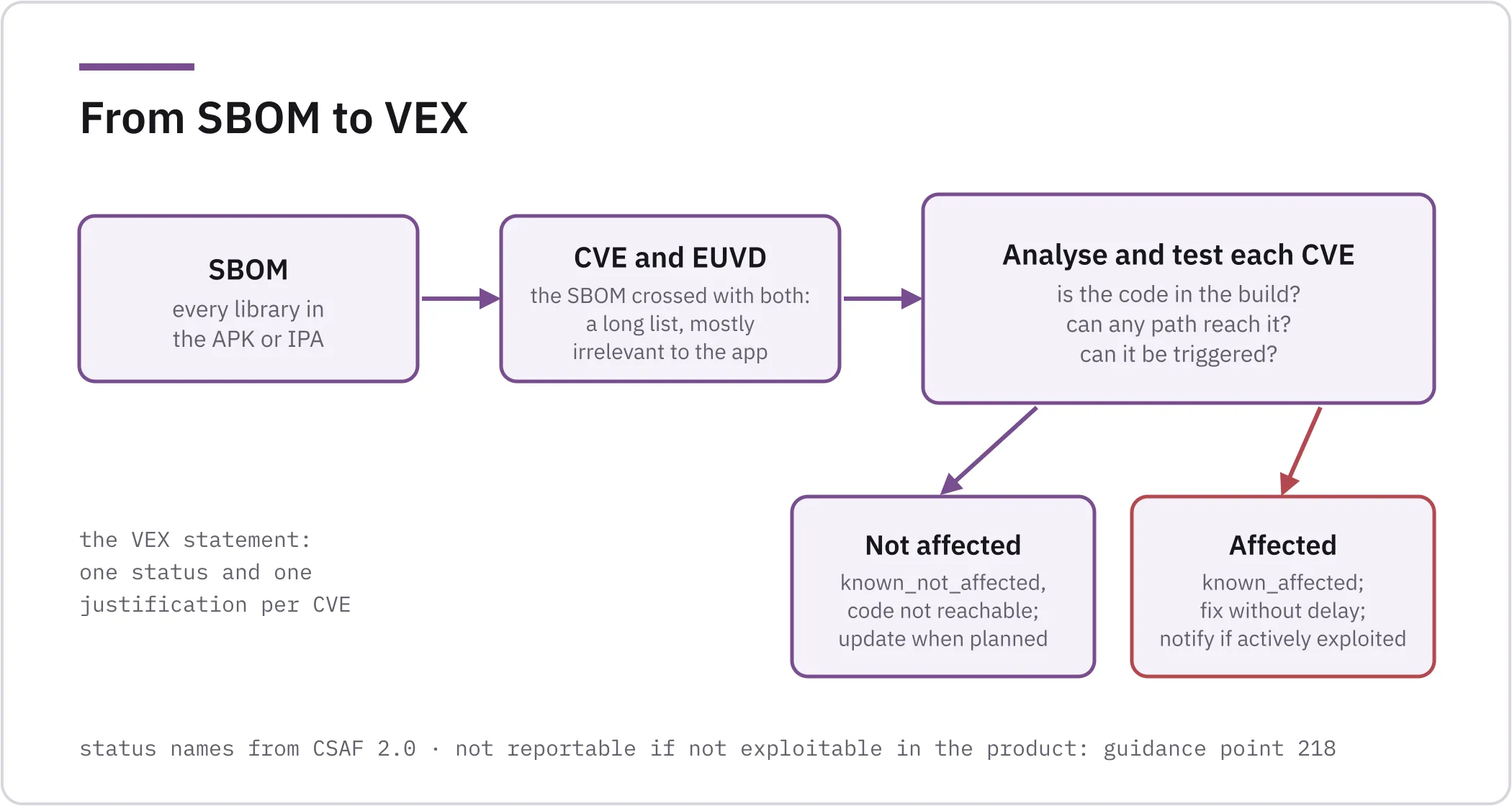
For a “not affected” entry to hold up in front of an authority, the code has to be missing from the build or unreachable, and a test that runs the app has to back that up. A component vulnerability that is unexploitable in your product falls outside reporting under Article 14 (point 218), but you still handle it under Part II.
How often to test
You have to apply “effective and regular tests and reviews” to your product (Part II, point 3), with regression tests when the product changes (points 238 to 240 of the Commission’s guidance). For an app that ships every two weeks, I doubt a yearly pentest meets that on its own.
When the supermarket changes how the checkout barcode is generated, for example, you rerun the tests that touch that flow and record which ones and why. Between releases, the same analysis can run from the continuous integration pipeline on every build, which is what our platform, now in early access, is built for. Mobile app security testing in CI/CD follows Demo Market through a year of releases.
Which other CRA obligations can a test still check?
Two more, besides the SBOM, the VEX and the regular tests above: fixes and update distribution.
- Fixes: retest each one before you call the vulnerability remediated (Part II, point 2).
- Update distribution: check that builds are signed and that the API turns away versions older than the minimum you support (points 7 and 8).
The CRA asks for more than the properties in Annex I: the risk assessment, vulnerability handling for the whole support period, incident reporting and the technical documentation. The MASTG was never meant to cover any of that, and most of it is process that someone in your company has to own.
Which obligations do your own records prove?
Your own records are the evidence for the rest. Those obligations still belong on your list, and test results feed several of them:
- The risk assessment (Article 13) states whether and how each Annex I property applies, and why. The MAS profiles and the tests you choose follow from it.
- Disclosure of fixed vulnerabilities (Part II, point 4) means publishing information once a fix is out. A finding written up with its severity, CVSS vector, CWE weakness class and fix is most of that advisory.
- The disclosure policy and the contact address (points 5 and 6) need a policy and an inbox that someone answers. Sending a test report to that address shows whether it works.
- Reporting under Article 14 means detecting exploitation and notifying within the deadlines above. A technical analysis of the exploited vulnerability supports the notification and the final report.
- The technical documentation (Annex VII) holds the file and the declaration of conformity, and the test reports go into it under point 6.
Where each CRA requirement gets its evidence
Each row says whether the evidence for a CRA requirement comes from the MASTG for the app, from ASVS and the WSTG for the RDPS, from tests that no OWASP standard has yet, or from your own process. Yes means that source covers its part of the requirement, Partly means it covers some of it, and an empty cell means it plays no part. Tests cover most of Part I, and the further down the table, the more of the evidence comes from your own process:
| CRA requirement | MASTG (app) | ASVS and WSTG (RDPS) | Testable, in no OWASP standard | Process |
|---|---|---|---|---|
| Annex I, Part I: properties of the product | ||||
| (a) No known exploitable vulnerabilities | Partly | Yes | Partly | |
| (b) Secure defaults and reset | Partly | Yes | Yes | |
| (c) Security updates | Partly | Yes | Yes | Partly |
| (d) Protection from unauthorised access, and reporting it | Yes | Yes | ||
| (e) Confidentiality of data | Yes | Yes | ||
| (f) Integrity, and reporting corruption | Partly | Partly | Yes | |
| (g) Data minimisation | Partly | Partly | Partly | |
| (h) Availability | Partly | Yes | ||
| (i) Impact on other networks | Partly | Yes | ||
| (j) Limited attack surface | Yes | Yes | ||
| (k) Exploitation mitigation | Yes | Partly | ||
| (l) Recording security events, with an opt-out | Partly | Yes | ||
| (m) Data removal and transfer | Partly | Partly | Yes | |
| Annex I, Part II: vulnerability handling | ||||
| (1) SBOM | Partly | Yes | Yes | |
| (2) Remediation without delay | Partly | Yes | Yes | |
| (3) Regular tests and reviews | Yes | Yes | Yes | Partly |
| (4) Disclosure of fixed vulnerabilities | Yes | |||
| (5) and (6) Disclosure policy and contact address | Yes | |||
| (7) and (8) Secure, free update distribution | Partly | Yes | Yes | |
| Other obligations | ||||
| Risk assessment (Article 13) | Yes | |||
| Reporting (Article 14) | Yes | |||
| Technical documentation (Annex VII) | Yes |
What to show a market surveillance authority
A market surveillance authority that looks at your app will start by asking for papers: the declaration of conformity and the technical documentation, with the risk assessment and the reports of the tests you ran.
We propose this method for CRA testing of mobile apps: MASTG tests for the app with the profiles your risk assessment sets, ASVS and WSTG for the API, the added tests for what OWASP MAS does not reach, and a VEX statement for the components in your SBOM. When a customer or regulator asks for MASVS by name, the OWASP MASVS assessment covers the app on its own.
Jacobo Casado (@jacobocasado) and Sergio García (@sgIOlas) are credited in the MASTG v2.0.0 release notes with porting v1 tests, mostly from MASVS-RESILIENCE, into 17 new tests and 16 runnable demos, and the same notes name vulnit an OWASP MAS Advocate. Jacobo and Sergio are also credited as members of the MAS Task Force in the MASWE v1.0.0 release.
Where you start depends on what you have:
- If you already have a MASTG report, send us its scope and profiles and we will tell you which points of Annex I it leaves open.
- If you have no report yet, or you are unsure what the CRA asks of your app or which profile to choose, contact us. In a scoping call we look at what applies to your app and which tests your technical documentation needs. If you need more support before testing, we can start with a consulting engagement and plan the testing afterwards.
References
- Regulation (EU) 2024/2847 (Cyber Resilience Act), EUR-Lex
- Commission Implementing Regulation (EU) 2025/2392 on the technical description of important and critical products, EUR-Lex
- Commission guidance on the application of the Cyber Resilience Act, C(2026) 5252, European Commission
- Standardisation request to CEN, CENELEC and ETSI, C(2025) 618, European Commission
- OWASP MASVS v2.1.0, OWASP
- OWASP MASTG v2.0.0 release notes, OWASP
- OWASP MASWE v1.0.0 release, OWASP
- OWASP MAS Testing Profiles, OWASP
- OWASP Application Security Verification Standard, OWASP
- OWASP Web Security Testing Guide, OWASP
- European Vulnerability Database (EUVD), ENISA
- Common Security Advisory Framework (CSAF) 2.0, OASIS
- CycloneDX: Vulnerability Exploitability eXchange (VEX), CycloneDX