
Mobile app security testing in CI/CD: test every release
A yearly pentest tests one of 26 releases of an app that ships every two weeks. Test every build from CI/CD and keep the pentest for business logic and reports.
If your app ships every two weeks, that is 26 releases a year. A yearly pentest tests one and retests the fixes on the next, so it checks 2. Tests run by your continuous integration and delivery (CI/CD) pipeline can check the other 24 before they ship. Keep the pentest for business logic and for the report your customers ask for, where a specialist checks every finding.
TL;DR
- Covers: How to test every build of your Android or iOS app from CI/CD with vulnit Platform, what lands in your tracker, and when you need a human pentest.
- Not covered here: What else to put in your own pipeline, such as static analysis (SAST) or other scanners. The CRA gets one short answer here; for the rest, read whether it applies to your app and how it maps to MASTG tests.
- First step: Take the last regression found after it shipped, and check whether your pipeline would catch it today.
What does a yearly pentest leave untested?
Take Demo Market, a fictional supermarket loyalty app where customers collect points, activate coupons, show a barcode at the till and can save a card for home delivery. The sections below follow its releases through one year. Its team ships every two weeks. In January an external pentest finds two medium-severity issues, the next release fixes them, and the retest confirms the fixes.
In March, while working on release 6, a developer wants to watch the app’s traffic through a proxy in the test environment. The app has its own trust manager, which hands each server certificate to Android’s default trust manager, and the proxy’s certificate keeps failing that check. So the developer wraps the call in a try and catch that logs the error and carries on, and the change goes out with the release. From then on, anyone who can sit between a customer and the server, on a café’s Wi-Fi for instance, can read and change the traffic on the connections that use that trust manager. With the session token in that traffic, they can take over the account and order a delivery paid with the customer’s saved card, sent to an address of their choosing.
The Open Worldwide Application Security Project (OWASP) publishes tests for flaws like this one. Its Mobile Application Security (MAS) project sets the requirements for a secure app in the Mobile Application Security Verification Standard (MASVS, v2.1.0 of 18 January 2024), and the tests that check them in the Mobile Application Security Testing Guide (MASTG, v2.0.0 of 30 June 2026). The unsafe trust managers to look for are listed in MASTG-TEST-0282, and two of them describe release 6: one that catches validation errors and suppresses them, and one that loosens trust “for convenience during development or testing”.
Android Lint has two warnings for trust managers, and exceptions caught inside checkServerTrusted are a pitfall in Google Play’s guidance on unsafe trust managers. None of these checks points at the new catch block while its pull request is open:
| Check | What it does with release 6 |
|---|---|
| Android Lint, TrustAllX509TrustManager | Stays silent. It flags check methods that do nothing, but Demo Market’s trust manager still calls the default trust manager before it swallows the error. |
| Android Lint, CustomX509TrustManager | Fires as before. It flags any custom trust manager, and it had been firing on Demo Market’s class since long before release 6, so the new catch block left it as it was. |
| Google Play | May flag the build in the Play Console when you upload it, and may hold back an update that still contains the catch block. |
Both Play warnings come at release time or later, long after the pull request that introduced the catch block. If Play misses the flaw, the next test that looks for it is the January pentest, 21 releases later.
Does the CRA ask for more than a yearly test?
If the EU Cyber Resilience Act (CRA) covers your app, from 11 December 2027 you have to “apply effective and regular tests and reviews of the security of the product” (Annex I, Part II, point 3). A person or a pipeline can run them. “Regular” means checking whether new threats call for new tests, with regression tests when the product changes. How often depends on the product’s risk, how it changes and the threats it faces (the Commission’s guidance on applying the CRA, C(2026) 5252 of 27 July 2026, points 238 to 240).
With 26 releases a year, one pentest leaves 24 of them to chance, and I don’t think that meets this requirement. Testing only the releases flagged as security changes would have skipped release 6 too, because the change was a debugging leftover that never made the changelog. How often to test under the CRA is covered in OWASP MASTG for CRA compliance.
What runs on every build, and what lands in your tracker?
With vulnit Platform in its pipeline, Demo Market analyses the release build of every pull request, so every release goes through the same checks before it ships. The checks that run the app cover the screens they reach, as explained below. The platform automates the analysis our specialists run in their own assessments, for Android and iOS apps and the backend APIs those apps call. A pipeline can start it from GitHub Actions, GitLab CI/CD, Bitbucket Pipelines, Jenkins or Azure DevOps, or through a CLI and an API. Each result opens a ticket in the team’s tracker and shows up as a status check on the pull request, or on the merge request in GitLab.
In the pull request that adds the catch block, the platform runs more than 150 checks based on the OWASP MASTG. The one for MASTG-TEST-0282 looks for a checkServerTrusted that catches a validation error without throwing it again. In the MASTG, that inspection is left to a person. The platform’s check applies fixed rules to the decompiled code, so the same build always gives the same result. On the release 6 build, the status check fails. The ticket points at the catch block and gives the steps to reproduce the flaw, its impact and the fix. It also names the MASVS control the code breaks and the MASTG test that found the flaw.
The platform runs the app too. On Android, it does so on Chameleon, our modified version of Android, which records the app’s system calls, file access and network traffic from the operating system side. While AI agents drive the app through its screens, the platform puts a proxy with an untrusted certificate between the app and the server. On the release 6 build the connection goes through, and the decrypted request carrying the session token goes into the ticket as evidence, next to the device log.
The agents record each flow as a sequence of screens and taps, and replaying it on the same build usually reproduces the result, unless the backend’s data or a time-limited coupon has changed in between. A dynamic check only covers the screens the agents reach. A new coupon screen is tested once the agents reach it, and that may happen after the pull request that adds the screen.
The developer deletes the custom trust manager altogether, so the app falls back to Android’s own certificate validation. A custom checkServerTrusted is error prone when the Network Security Configuration would do (in the MASTG’s words), and here it does. A <debug-overrides> block with <certificates src="user"/> in the Network Security Configuration trusts the CA certificates installed on the test phone only when the app is debuggable, which the test-environment build is. Release builds ignore the block. The developer reruns the MASTG-TEST-0282 check to confirm the fix, and the next push passes the status check.
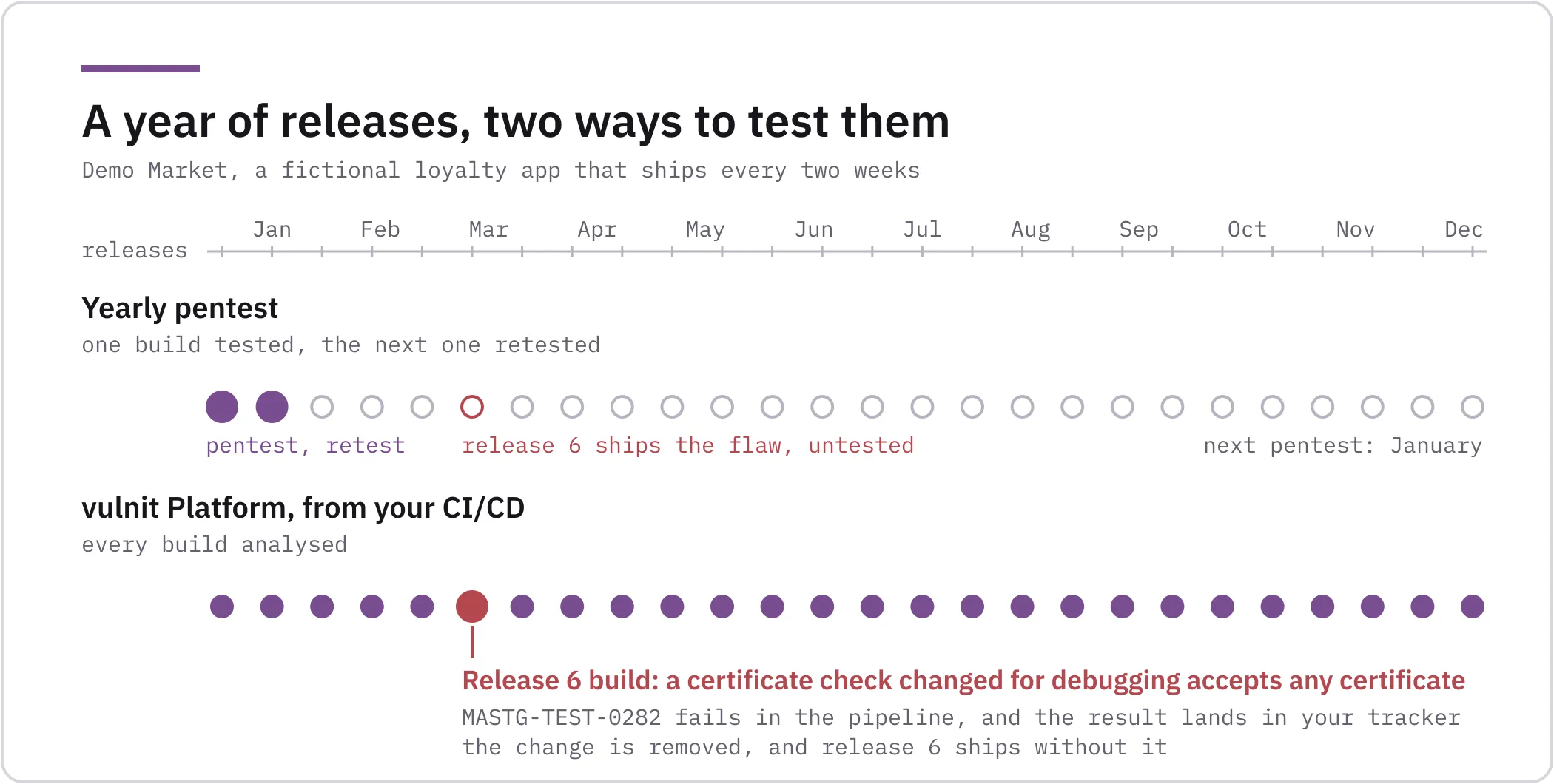
Over Demo Market’s year, the yearly pentest reaches 2 releases and vulnit Platform all 26. Each dot is a release: filled dots were analysed, hollow dots were never tested, and the red dot is release 6:
When do you need a human pentest?
Nobody at vulnit reviews the platform’s findings before they reach your tracker. At Demo Market the developer who wrote the catch block read the ticket and fixed it. But your customers often set how often you commission a pentest, and a business customer may ask for a new report every year. Their security review or an auditor will want a specialist to have checked each finding, and to know which findings are real and which to fix first.
A mobile app penetration test gives them that. Our specialists lead it, and it gives you:
- Every finding validated by a specialist before it reaches you.
- Tests of the business logic: at Demo Market, whether a coupon can be redeemed twice, or points collected with another customer’s barcode.
- A report that shows the evidence for each finding, scores it with the Common Vulnerability Scoring System (CVSS 4.0) and gives it its class in the Common Weakness Enumeration (CWE).
- On request, a signed letter with the version tested, the date and the result, for a customer who wants proof without the details. We update it after the retest.
Two of our specialists, Jacobo Casado (@jacobocasado) and Sergio García (@sgIOlas), ported tests into MASTG v2.0.0, mostly on resilience against reverse engineering, and the MASTG v2.0.0 release notes name vulnit an OWASP MAS Advocate.
Where do you start?
If a release is coming and a customer has asked for a pentest report, start with a mobile app penetration test. You send us the builds, and you get back a report like this sample pentest report, with a signed letter on request.
To test every build, take the last regression that a pentest or a user found after it shipped, and ask whether anything in your pipeline would catch it today. If nothing would, that is the first test to run on every build. To try vulnit Platform on your pipeline, talk to us about early access and tell us which CI you use.
References
- Regulation (EU) 2024/2847 (Cyber Resilience Act), EUR-Lex
- Commission guidance on the application of the Cyber Resilience Act, C(2026) 5252, European Commission
- OWASP MASVS v2.1.0, OWASP
- OWASP MASTG v2.0.0 release notes, OWASP
- MASTG-TEST-0282: Unsafe Custom Trust Evaluation, OWASP
- Network security configuration: debug-only overrides, Android Developers
- TrustAllX509TrustManager lint check, Android Lint
- How to fix apps containing an unsafe implementation of TrustManager, Google Play Console Help
- CVSS v4.0 specification, FIRST
- Common Weakness Enumeration, MITRE