
Does the CRA apply to my mobile app if I sell no hardware?
Most apps you supply to EU users as part of your business are CRA products, free or paid, and the backend modules they talk to are part of them.
If you publish an Android or iOS app for EU users as part of your business, the Cyber Resilience Act (CRA) treats the app as a product, even if you sell no hardware and the app is free. The backend modules that the app talks to are part of that product, but a browser-only website stays out.
TL;DR
- Covers: This article settles which apps, backend modules and websites the CRA reaches, who the manufacturer is when an agency builds the app, which category the app falls in, and what already applies to an app that is in the stores today.
- Not covered here: The conformity route for each category and what a notified body checks are in CRA conformity assessment for mobile apps. The tests that give evidence for Annex I are in OWASP MASTG for CRA compliance.
- First step: List every endpoint your app calls, the module it runs in and who built it.
Each section below checks its question against one example: a second-hand marketplace with a free app, a website and one backend behind both. It earns a commission on each sale.
Which apps does the CRA cover, free or paid?
The CRA covers “products with digital elements”, which Regulation (EU) 2024/2847 defines as software or hardware together with its remote data processing solutions. An app that a user downloads from a store and installs on their phone is such a product, according to the Commission’s guidance of 27 July 2026, and it may fall within the scope of the CRA when it is supplied in the course of a commercial activity.
That commercial activity does not need a price. The CRA covers supply “whether in return for payment or free of charge”. A supply can be commercial in other ways too (recital 15). One is the intention to monetise through a platform on which the maker sells other services. The second-hand marketplace earns exactly that way. Another is an app that sells nothing but makes the processing of personal data a condition of use, for purposes beyond security, compatibility or interoperability.
The guidance uses a different marketplace in its Example 14: an open-source app that earns through advertising, commissions or subscriptions. That open-source marketplace app counts as placed on the market. The CRA treats open source with the most care. So if it catches that open-source app, it catches a closed one too.
Nor does the app need a public store. Software counts whether it is downloaded, installed or otherwise supplied to the user, according to the guidance, so a direct download or an enterprise channel counts as well. But the supply still has to be commercial. My reading is that an app through which money moves for a service you sell to others meets that test even when it is not publicly available, because it is the platform through which you monetise that service, in the words of recital 15. A separate app that the second-hand marketplace gave its professional sellers by direct download, to manage their payouts, would be in scope. Apps used only by your own staff are a different case: you do not supply them to anyone, so you do not place them on the market.
Medical device software is the main exclusion for apps. Products covered by the regulations on medical devices and in vitro diagnostics stay outside the CRA (Article 2(2)).
Most of these cases are in scope. Staff-only apps and medical device software stay out:
| Case | In scope? |
|---|---|
| An app you charge for | Yes |
| A free app through which you monetise a platform where you sell other services, like the second-hand marketplace | Yes (recital 15) |
| A free app that makes the processing of personal data a condition of use, for purposes beyond security, compatibility or interoperability | Yes (recital 15) |
| An open-source app that earns through advertising, commissions or subscriptions (the guidance’s Example 14) | Yes, it counts as placed on the market |
| An app supplied by direct download or through an enterprise channel | Yes, if the supply is commercial |
| An app used only by your own staff | No, you do not place it on the market |
| Medical device software | No (Article 2(2)) |
Does the CRA cover my backend and my website?
When a mobile app needs an API or a database provided by a service the manufacturer developed, that service is in scope as remote data processing (recital 11 of the CRA names this exact case). Remote data processing has three elements in the Commission guidance: the processing happens at a distance, the app would lose one of its functions without it, and the software was designed and developed by you or built to your specifications. The second-hand marketplace’s listings and payments API meets all three.
Only the software modules the app talks to directly, and their interfaces, count. Take the guidance’s mobile banking example. The interface that authenticates the customer and takes transfer orders is in, but the ledger behind it is out, because the app never reaches it.
A web application used only through a browser, progressive web apps included, is not a product. It comes in only where it supports a function of a product, for example a login portal that issues the tokens your app needs. On its own, then, the second-hand marketplace’s website is out.
The harder case is the backend that the website and the app share. The guidance does not address it directly. The unit of analysis in the guidance is the software module and its interfaces. My reading is that an endpoint the app calls is remote data processing even if the website calls it too, and that endpoints only the website uses stay out when they live in separate modules or deployments. But when those website-only endpoints run in the same service as the app’s endpoints, they share that service’s process, authentication and code. A flaw in them is then a flaw in your remote data processing.
What sits behind the modules in scope still goes into your risk assessment, as a dependency. The ledger in the guidance’s banking example is out of scope, yet an attacker who compromised it could influence the transaction results that the app displays. The second-hand marketplace’s own database sits behind its endpoints in the same way, so it is a dependency that you assess for risk.
A direct call is not enough to make a remote service yours, though, because what decides is who built it. What you build can be remote data processing, and what a vendor builds is a third-party service or component:
| Case | How the CRA treats it |
|---|---|
| A database service you developed | Remote data processing, if the app queries it |
| A hosted database from a cloud provider | A third-party service |
| Functions you write and deploy on that cloud platform | Your software, which the guidance treats as possible remote data processing |
| A support chat built and hosted by a vendor (the guidance’s banking example) | Like a third-party component: you assess the risks it brings and exercise due diligence on it |
| A payment processor | The same treatment as the vendor’s support chat |
| A vendor’s SDK compiled into your app | A component in the plain sense, with the same due diligence required by Article 13(5) |
Who is the manufacturer when an agency built the app
The manufacturer is whoever develops a product, or has it designed and developed, and markets it under its name or trademark (Article 3(13)). When an agency builds the second-hand marketplace’s app and the marketplace publishes it under its own brand, the obligations sit with the marketplace. The contract with the agency can only share out the work of producing the evidence. You are also the manufacturer of a white-label app that you publish under your brand, under the same definition. An importer or distributor that places a product on the market under its own name becomes the manufacturer too (Article 21).
Which CRA category is my app in?
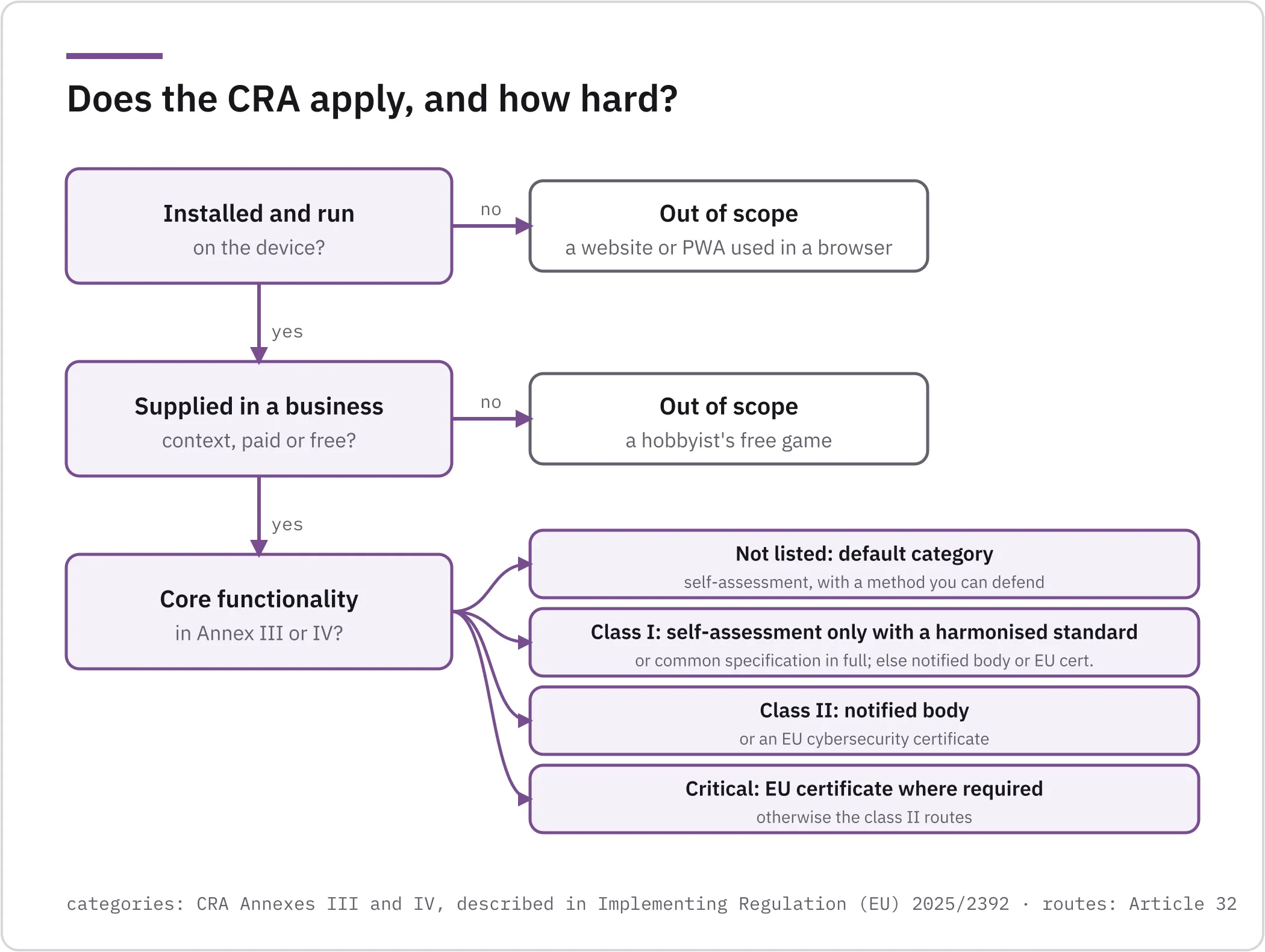
The category, and with it the conformity route, depends on the product’s core functionality (Article 7(1)). The important products are in Annex III, whose class I includes password managers, VPNs, browsers, identity management systems and smart home products with security functions. Those categories are described in detail in Implementing Regulation (EU) 2025/2392. There, identity management includes one-time password software, authentication software and multi-factor authentication software, and smart home security products include the software that centrally controls them. That last category reaches an app maker without hardware whose app controls locks, cameras or alarms made by others. The app that a lock maker ships for its own lock is a different case. That app counts as part of the lock in the guidance, so it follows the lock’s route.
Integrating one of those functions does not in itself change the category (Article 7(1)), as with a news app that has an embedded browser (recital 3 of Implementing Regulation 2025/2392). My reading is that a banking app with strong login stays in the default category, because its core function is banking and the authentication serves it. A separate authenticator app that only generates codes or approves logins for the bank’s other channels is another product, though. Its core function is authentication, and that puts it in class I. For the same reason, the second-hand marketplace’s own login does not turn its app into an identity management system.
In the same way, a product whose core functionality is in class I stays in class I even when it adds features that only complement that functionality. And a manufacturer has to describe its core functionality as what the product actually does.
Products outside Annex III and Annex IV are in the default category, where the manufacturer can assess conformity itself. A class I product needs a notified body unless its manufacturer fully applies harmonised standards cited in the Official Journal, common specifications or a European cybersecurity certification scheme at assurance level “substantial” or higher. Each route, and what a notified body checks, is in CRA conformity assessment for mobile apps.
Scope depends on whether the app is installed on the device and supplied as part of your business. Its core functionality then sets the category and the conformity route:
What changes for an app already in the stores
Most of the regulation applies from 11 December 2027. An app placed on the market before that date is subject to the product requirements only if it undergoes a substantial modification afterwards, although the reporting obligations below apply to it already. Software counts as placed on the market on the day you first offer a version, according to the guidance, and updates that are not substantial modifications keep that date. That date applies to one build only, because builds for different operating systems are separate products. If the second-hand marketplace released its iOS app for the first time in 2028, that build would need full CRA conformity from its first day, even if the Android app dates from 2025.
A substantial modification is a change that affects compliance with the product requirements in Part I of Annex I, or that changes the intended purpose the product was assessed for. A change affects compliance when it brings new cybersecurity risk that the risk assessment did not cover, in the guidance’s reading. So the size of the change is irrelevant. A “remember me” option that stores login tokens on the device leaves the app substantially modified (Example 44 of the guidance). Security fixes, by contrast, generally are not substantial modifications, even when the code changes a lot.
For an app placed on the market before 11 December 2027, a substantial modification does not always bring the whole app into scope. The obligations cover only the modified parts, unless the change harms the cybersecurity of the app as a whole (point 124 of the guidance). A feature with its own module and its own data fits that limit. An in-app wallet added to the second-hand marketplace in 2028 would not fit it, because the wallet shares the session, the stored tokens and the payments backend with the rest of the app. The wallet would likely bring the whole app into scope.
My advice for a team that ships every week is a risk assessment that covers the roadmap. In the guidance’s messaging app example, the risk assessment foresees group chats, with their risks assessed and their mitigations designed, so the release that adds them is not a substantial modification. That only works if your assessment does the same for each planned feature, rather than listing features.
I would write that assessment now for an app that predates the CRA. Nothing in the guidance says how an assessment written before the CRA applied will be treated, so make it as specific as one written for a conformity assessment.
Reporting applies already, since 11 September 2026, and it covers apps placed on the market earlier. A manufacturer that becomes aware of an actively exploited vulnerability in its app, or of a severe incident affecting its security, must notify ENISA and the CSIRT designated as coordinator in the Member State of its main establishment, through the single reporting platform. It also has to tell affected users. A flaw in the second-hand marketplace’s listings API that attackers use to take over accounts would count, even if the fix is deployed only on the server.
You become aware once a prompt initial assessment gives you reasonable certainty, according to the guidance. From then, each report has its own deadline:
| Report | Deadline |
|---|---|
| Early warning | Within 24 hours |
| Notification | Within 72 hours |
| Final report on a vulnerability | Within 14 days of a fix being available |
| Final report on an incident | Within one month of the notification |
What your team can collect now
You can collect all of these before you settle any question of interpretation, and the rest of the work builds on them:
- every app and every platform build that you publish under your brand for EU users, including apps you distribute outside the stores;
- every endpoint each app calls, the module it runs in, who wrote it and what sits behind it;
- the third-party SDKs in the app and the hosted services it relies on;
- the app’s core function, checked against Annex III;
- the features planned for the next releases, so that the risk assessment can cover them;
- who makes the initial assessment of a reported exploitation or incident, and who sends the early warning within 24 hours.
What testing does the CRA ask for?
The vulnerability handling requirements in Part II of Annex I include “effective and regular tests and reviews” of the product’s security, and for an app-only maker that product is the app plus the backend modules it talks to. Our CRA testing for mobile apps covers the Android and iOS app and the backend interfaces it relies on, and we write the report so that it can go into your technical documentation. We map those tests to OWASP MASVS and the MASTG, where Jacobo Casado and Sergio García contributed the MASVS-RESILIENCE tests that made vulnit an OWASP MAS Advocate. MASVS is not a harmonised standard, so it gives no presumption of conformity. It does give each test a public reference that a reviewer can check.
If you are not sure which endpoints of your app the CRA covers, tell us what your app calls and we will work out the scope with you in a first call. If your doubt goes beyond scope, to what the CRA asks of your app, we start there too. In a scoping call we look at what applies to your app and which tests your technical documentation needs. If you need more support before testing, we can start with a consulting engagement.
References